


Kanematsu Corporation (“Kanematsu”) collaborated with Shikishima Farm Co., Ltd. (“Shikishima Farm”) and dsm-firmenich AG (“dsm-firmenich”) to conduct a preparatory commercial feeding of Bovaer®*1, a feed additive that reduces enteric methane emissions from cattle, on Japanese Black cattle raised by Shikishima Farm. Aimed at reducing the environmental burden of the livestock supply chain, this is the world’s first initiative toward commercial use of Bovaer® on Japanese Black cattle.
*1. Bovaer® is the only feed additive for reducing cattle digestive tract methane emissions whose safety and effectiveness have been approved by governments and regulatory authorities in countries around the world, including Japan and now commercially available in 70 countries.
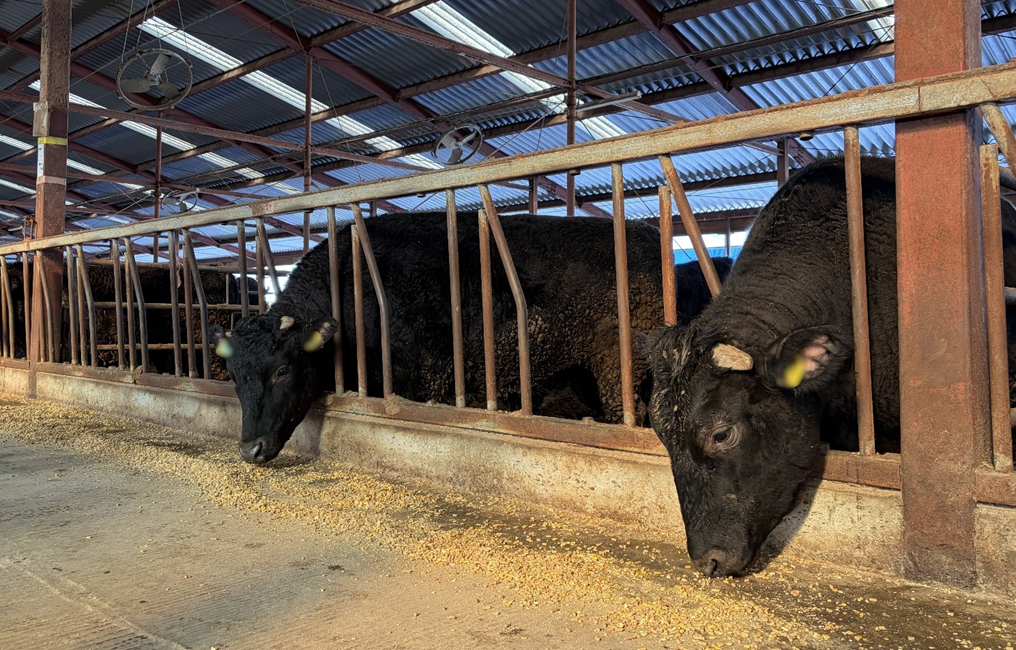 Shikishima Farm’s Japanese Black cattle feeding
Burps from cattle and other ruminants release methane (enteric methane), a greenhouse gas that poses environmental challenges for the livestock industry. According to the National Agriculture and Food Research Organization (NARO), this enteric methane is the second-largest source of methane emissions after rice farming in Japanese agricultural industries, and is said to account for approximately 5% of total global greenhouse gas emissions from all industries. In Japan in December 2025, J-Credit Scheme Steering Committee approved the formulation of a new methodology regarding feeding cattle with additive-blended feed, and preparations are underway for its registration under the scheme.
Developed by dsm-firmenich, Bovaer® is a feed additive that reduces enteric methane emissions by an average of 30% for dairy cows and an average of 45% for feedlot beef cattle, while ensuring the taste and quality of milk and beef. Bovaer® has been introduced in several hundred farms across Europe, the United States, South America, and Australia, contributing to a cumulative reduction of methane emissions equivalent to approximately 600,000 tons of CO2 according to the manufacturer’s estimates.
In July 2025, Kanematsu and dsm-firmenich entered into a partnership agreement for the joint promotion of environmental value creation through Bovaer®, as well as the distribution of value-added livestock products. As a joint initiative under this partnership agreement, the preparatory commercial feeding was conducted by Kanematsu, Shikishima Farm, and dsm-firmenich to verify the optimal feeding conditions and methods for Japanese Black cattle, appropriate documentation methods, and feasibility of J-credit creation in the future.
Preparatory commercial feeding details
●Period: 70-day period from November 2025 ●Site: Shikishima Farm’s Shiraoi Ranch (Hokkaido)
●Cattle: 24 Japanese Black cattle ●Method: Add Bovaer® to regular feed at the same time each day
The preparatory feeding results were as follows:
(1) As Bovaer® can be used by simply blending with existing feed, there was no significant increase in the feeding-related workload.
(2) The cattle exhibited favorable feeding behavior both during and after feeding Bovaer®, and it was completed safely with no issues regarding herd behavior, growth, or health.
(3) The preparatory feeding is estimated to have contributed to the reduction of enteric methane emissions equivalent to approximately 5.5 tons of CO2e.
We will continue to work with Shikishima Farm, dsm-firmenich, and our customers to advance our carbon insetting*2 initiatives, providing livestock products combined with environmental value created through reducing methane emitted from Japanese Black and other livestock. Through these efforts, we will contribute to the reduction of Shikishima Farm’s Scope 1 emissions, as well as the Scope 3 (Category 1) emissions from our customers further downstream in the supply chain, paving the way toward building a sustainable food supply chain.
*2 Carbon insetting:A strategy whereby the benefits of GHG emissions reduction and elimination efforts carried out within a supply chain are leveraged within the same supply chain (e.g., acquiring or retiring carbon credits created by producers, utilizing those credits to reduce product emissions). Antonym of carbon offsetting, which involves tapping into environmental value created outside of the supply chain (e.g., acquiring carbon credits created by companies in other supply chains).
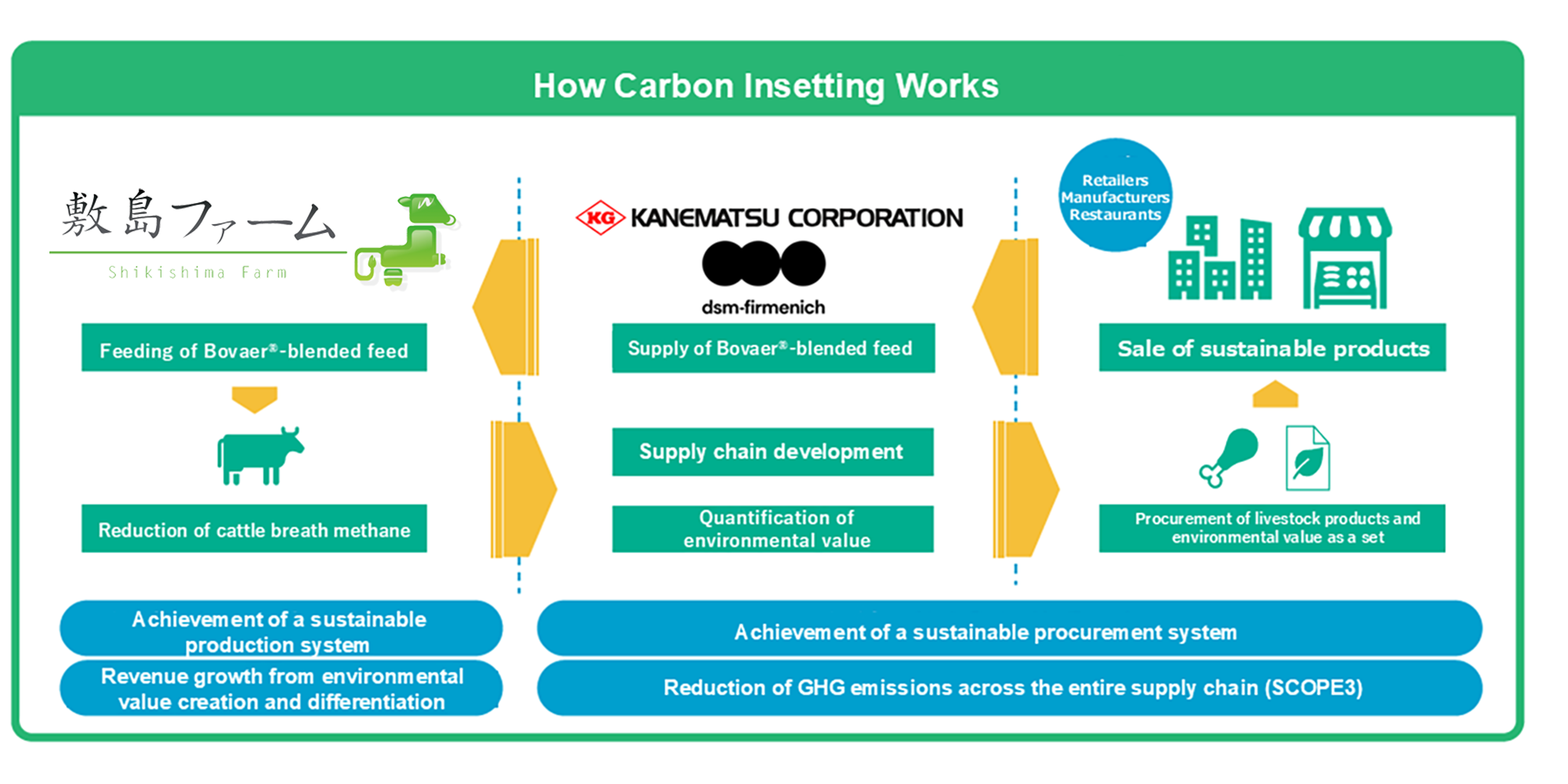
◆ List of Kanematsu’s carbon insetting initiatives (press releases)
- Kanematsu signed Partnership Agreement with The Norinchukin Bank to Address Global Warming Issues in the Agriculture and Food Industries
- Kanematsu enters into a partnership agreement with Denmark’s Danish Crown to spread sustainable pork products in Japan
- Kanematsu enters into a partnership agreement with Green Carbon, Inc. aiming to reduce “rice paddy methane” emissions and spread environmentally friendly rice to address global warming
- Kanematsu and green and agritech venture TOWING partner to expand adoption of the high-performance biochar “Soratan” in Japan and the U.S.
- Kanematsu partners with Morinaga Milk Industry and TOWING to build a sustainable supply chain for Brazilian coffee beans
- Kanematsu invests in Nagoya University based green and agri-tech venture TOWING: Driving the development of sustainable food supply chains globally
- Kanematsu and dsm-firmenich start promoting joint initiatives for reducing the environmental impact of livestock products by utilizing a feed additive that reduces cattle methane emissions
- Kanematsu participates in the Insetting Consortium toward strengthening “GX for agriculture and food”
- Kanematsu begins supplying domestically produced rice combined with added environmental value to Skylark —Project to reduce supply chain emissions from raw ingredient production and procurement—
 Bovaer® — a feed additive that reduces enteric methane emissions from cattle
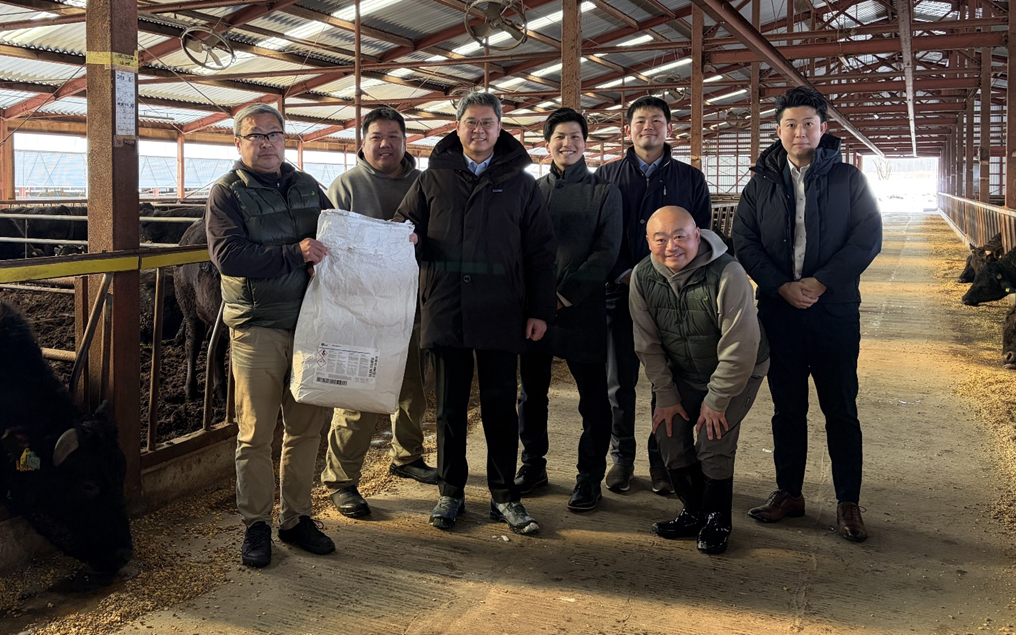 Group photo with the preparatory feeding participants
● Kanematsu Corporation
Green transformation is one of the key initiatives under integration 1.1, our three-year medium-term management plan launched in April 2024, with a priority area being “GX for Agriculture and Food.” We will continue to contribute to decarbonization and a circular economy through creating and supplying environmentally friendly food, aiming to make our key food supply chains more sustainable.
● About Shikishima Farm
With around 10,000 Japanese Black cattle on farms in Tochigi Prefecture and Hokkaido, Shikishima Farm aims to produce “zero-carbon beef”—beef produced and distributed with practically net-zero carbon emissions—through its completely integrated production system for livestock rearing. It promotes decarbonized, sustainable agriculture across its entire supply chain through diverse perspectives, including the introduction and development of greenhouse gas reduction technology, promotion of GX initiatives, expansion of circular agriculture, and carbon capture and storage.
URL:https://www.shikishima-farm.jp/
● About dsm-firmenich
As innovators in nutrition, health, and beauty, dsm-firmenich reinvents, manufactures, and combines vital nutrients, flavors, and fragrances for the world’s growing population to thrive. With its comprehensive range of solutions, combining natural and renewable ingredients with renowned science and technology capabilities, dsm-firmenich works to create what is essential for life, desirable for consumers, and more sustainable for the planet. dsm-firmenich is a Swiss company with dual headquarters in Kaiseraugst, Switzerland and Maastricht, Netherlands, listed on the Euronext Amsterdam, with operations in almost 60 countries and revenues of more than €12 billion. With a diverse, worldwide team of nearly 30,000 employees, it brings progress to life every day, everywhere, for billions of people.
URL:https://www.dsm-firmenich.com
【Contact】
Public Relations Section, Kanematsu Corporation TEL: +81-3-6747-5000 https://www.kanematsu.co.jp/en/inquiry/